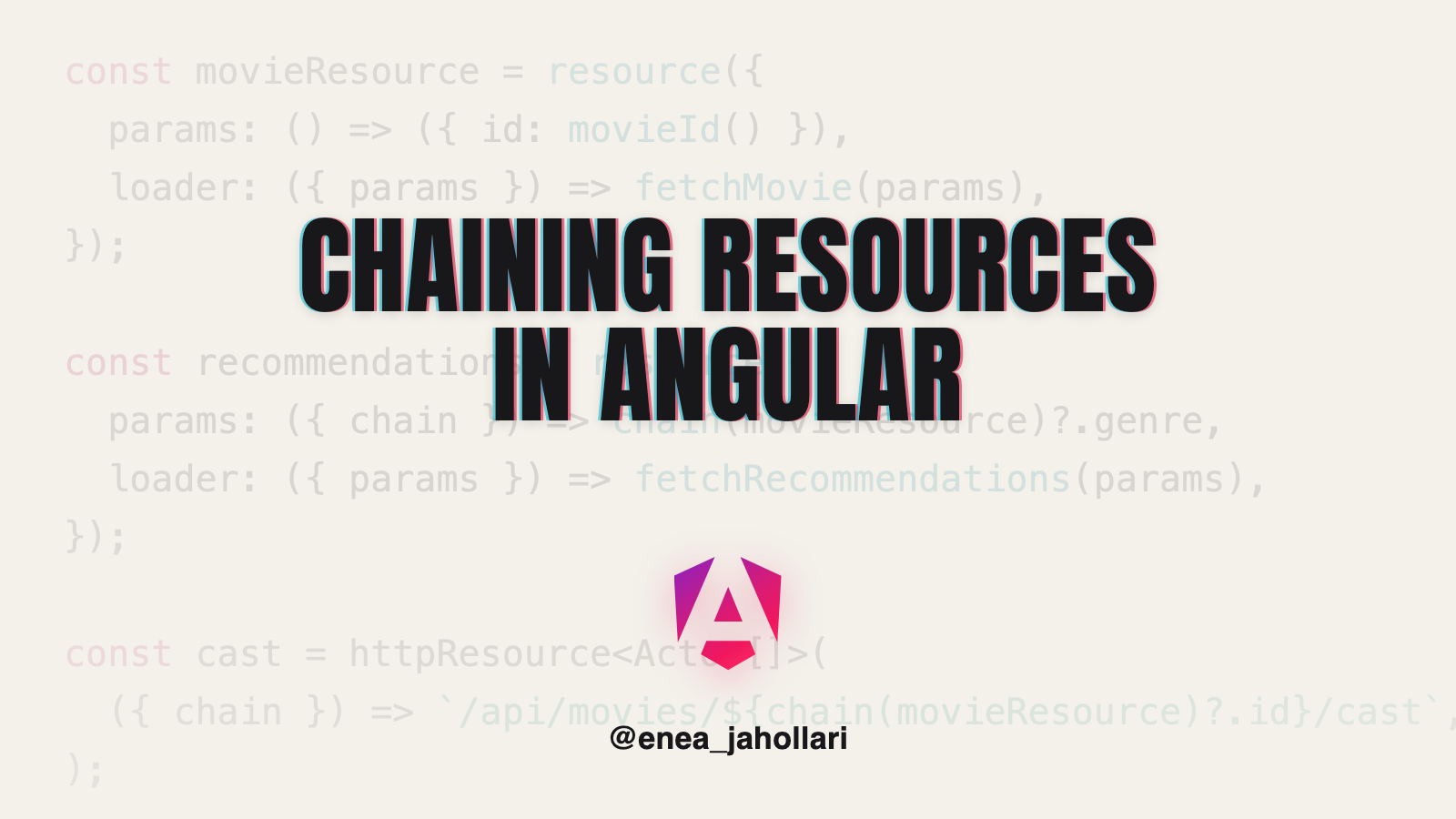
Give me chained resources Angular 🚀
You have a movieResource. You want to show recommendations next to it. But the recommendations endpoint needs the movie's genre, which only exists once the movie has loaded.
So you write this, it works, and it's also subtly wrong:
const recommendations = resource({
  params: () => {
    const movie = movieResource.value(); // undefined while loading 🤔
    return movie ? {genre: movie.genre} : undefined;
  },
  loader: ({params}) => fetchRecommendations(params.genre),
});
The bug isn't the data. The bug is the status. While movieResource is loading, recommendations reports idle — because params returned undefined, and undefined params means "no request at all". Your template asks recommendations.isLoading() and gets false, while the page is very obviously loading. And if movieResource errors? recommendations sits in idle forever, perfectly calm, telling you nothing is wrong. 😅
Angular v22 has an answer, and it's hiding somewhere you probably never looked: the argument to params.
How it works ✨
params receives a context object. Right now it holds exactly one thing — chain:
const movieResource = resource({
  params: () => ({id: movieId()}),
  loader: ({params}) => fetchMovie(params),
});

const recommendations = resource({
  // 👇 the params context
  params: ({chain}) => chain(movieResource)?.genre,
  loader: ({params: genre}) => fetchRecommendations(genre),
});
That's it. chain(movieResource) gives you the value and wires up status propagation:
movieResource is |
recommendations becomes |
|---|---|
idle |
idle — loader doesn't run |
loading |
loading ✅ |
reloading |
loading (⚠️ you do not get the old value) |
error |
error, wrapping the upstream error ✅ |
resolved / local |
chain returns the value, loader runs 🎉 |
Loading cascades. Errors cascade. idle cascades. No more undefined juggling.
The nice part:
chainis available anywhereparamsis. That meansresource,rxResource, and the url/request function ofhttpResource.
// httpResource gets it too 💎
const cast = httpResource<Actor[]>(
  ({chain}) => `/api/movies/${chain(movieResource)?.id}/cast`,
);
But how does it actually work 🎲
This is the fun part, and it's about 12 lines. Straight from packages/core/src/resource/resource.ts:
export function chain<T>(resource: Resource<T>): T {
  switch (resource.status()) {
    case 'idle':
      throw ResourceParamsStatus.IDLE;
    case 'error':
      throw new ResourceDependencyError(resource);
    case 'loading':
    case 'reloading':
      throw ResourceParamsStatus.LOADING;
  }
  return resource.value();
}
chain throws. That's the whole mechanism.
ResourceParamsStatus is a tiny Error subclass with two singleton instances, IDLE and LOADING, used as sentinels. On the other side, the resource wraps your params call in a try/catch inside a linkedSignal:
this.extRequest = linkedSignal<WrappedRequest>(() => {
  try {
    setInParamsFunction(true);
    return {request: request(paramsContext), reload: 0};
  } catch (error) {
    rethrowFatalErrors(error);
    if (error === ResourceParamsStatus.IDLE) {
      return {status: 'idle', reload: 0};      // 👈 sentinel → status
    } else if (error === ResourceParamsStatus.LOADING) {
      return {status: 'loading', reload: 0};
    }
    return {error: error as Error, reload: 0}; // 👈 anything else → error state
  } finally {
    setInParamsFunction(false);
  }
});
Three things worth staring at 👀
1. Reactivity survives the throw. chain calls resource.status() before it throws, and that read is tracked by the linkedSignal computation. So when the upstream status flips to resolved, params re-runs. The throw is pure control flow — it aborts the current computation, it doesn't unsubscribe you from anything.
2. Any thrown non-sentinel becomes an error state. Look at that last return. Throw a random Error from params and the resource lands in error with your error attached. chain's error case uses exactly this — it throws ResourceDependencyError, which carries .dependency (the upstream resource) and .cause (the actual upstream error). So you can tell "my request failed" from "my dependency's request failed":
const err = recommendations.error();
if (err instanceof ResourceDependencyError) {
  // this one is not my fault 😌
  console.log('upstream failed:', err.dependency, err.cause);
}
3. There's a guard rail. setInParamsFunction(true) — try to create a resource inside another resource's params and Angular throws invalidResourceCreationInParams at you. Which is what you want, because that would spawn a fresh resource on every params run.
Same "throw a special value to signal control flow" trick as RedirectCommand in the Router, by the way. The Angular team is clearly enjoying this pattern lately. ⚡️
Caveats 🤔
Don't wrap the chained value in an object.
// ❌ params is `{genre: undefined}` — a DEFINED value!
// the loader runs with an undefined genre
params: ({chain}) => ({genre: chain(movieResource)?.genre}),

// ✅ undefined params → resource goes idle
params: ({chain}) => chain(movieResource)?.genre,
reloading throws LOADING, not the previous value. When the parent reloads, the child drops to loading and loses its value. If you refresh the movie every time the tab regains focus, that's a recommendations flash on every focus. 👀
Don't reach for chain if you just need a derived value. No async work downstream? That's a computed. chain is for "this resource's request depends on that resource's value".
What we can build on top of this 💎
Here's where it gets fun. ResourceParamsStatus and ResourceDependencyError are public API. The throw protocol isn't a private Angular thing — it's a protocol we can speak.
1. Gate a resource on any signal, not just a resource
// throws the same sentinels Angular's own `chain` throws
function required<T>(value: T | null | undefined): T {
  if (value == null) throw ResourceParamsStatus.IDLE;
  return value;
}

function until(condition: boolean): void {
  if (!condition) throw ResourceParamsStatus.LOADING;
}

const watchProviders = resource({
  params: ({chain}) => {
    until(regionReady());                     // 👈 hold in `loading` until we know the region
    const region = required(selectedRegion()); // 👈 idle until the user picks one
    return {movieId: chain(movieResource).id, region};
  },
  loader: ({params}) => fetchWatchProviders(params),
});
Three different "not ready" reasons, one flat function body, zero nested ternaries. Same ergonomic win the Router got from throwable RedirectCommand — you stop threading "not ready" through return types.
2. chainAll — wait for several resources at once
Because the first chain that isn't ready throws, sequential calls already behave like an "all of these must be ready" combinator:
function chainAll<T extends readonly Resource<any>[]>(
  chain: <V>(r: Resource<V>) => V,
  resources: T,
) {
  // first not-ready resource short-circuits the whole params fn 🎯
  return resources.map((r) => chain(r)) as {
    [K in keyof T]: T[K] extends Resource<infer V> ? V : never;
  };
}

const personalized = resource({
  params: ({chain}) => {
    const [movie, profile] = chainAll(chain, [movieResource, profileResource]);
    return {genre: movie.genre, favoriteActors: profile.favoriteActors};
  },
  loader: ({params}) => fetchPersonalizedPicks(params),
});
Error priority falls out for free: whichever dependency errors first wins, and you get its ResourceDependencyError.
3. chainOr — optional dependencies
Sometimes an upstream failure shouldn't take you down with it:
function chainOr<T>(fn: () => T, fallback: T): T {
  try {
    return fn();
  } catch (e) {
    // let idle/loading through, swallow only real errors
    if (e instanceof ResourceParamsStatus) throw e;
    return fallback;
  }
}

const moviePage = resource({
  params: ({chain}) => ({
    movieId: chain(movieResource).id,
    // the third-party ratings API is down every other Tuesday, we don't care 🤷
    ratings: chainOr(() => chain(criticRatings), null),
  }),
  loader: ({params}) => fetchMoviePage(params),
});
Note it still rethrows the IDLE/LOADING sentinels — we want to wait, we just don't want to fail.
4. Kill the reloading flash with resourceFromSnapshots
Remember caveat #2? chain drops the value during reloading. But v22 also shipped snapshot + resourceFromSnapshots, and those compose with everything:
function keepPrevious<T>(input: Resource<T>): Resource<T> {
  const derived = linkedSignal<ResourceSnapshot<T>, ResourceSnapshot<T>>({
    source: input.snapshot,
    computation: (snap, previous) => {
      if (snap.status === 'loading' && previous && previous.value.status !== 'error') {
        return {status: 'resolved' as const, value: previous.value.value};
      }
      return snap;
    },
  });
  return resourceFromSnapshots(derived);
}

// 👇 the chain never sees `loading` on a refresh, so recommendations don't re-fetch
const stableMovie = keepPrevious(movieResource);
const recommendations = resource({
  params: ({chain}) => chain(stableMovie)?.genre,
  loader: ({params}) => fetchRecommendations(params),
});
Chain semantics become configurable, because chain reads the public Resource<T> interface and nothing else. Wrap the resource, change the chaining behaviour. That's a genuinely good API boundary. ✨
5. Debounced chains
debounced() also returns a Resource<T>, so it slots straight in:
const query = signal('');
const debouncedQuery = debounced(query, 300);

const actorSearch = resource({
  params: ({chain}) => ({
    genre: chain(movieResource).genre,
    q: chain(debouncedQuery), // waits for the debounce ⏱️
  }),
  loader: ({params}) => searchActors(params),
});
6. The Router is already doing this
There's an open PR (#69490) adding a routerResource(source: Resource<T>) that wraps any Resource<T> and freezes its state during navigation. Same trick: operate on the base interface, return a Resource<T>, compose. Wrap a chain head in routerResource and the whole downstream chain inherits navigation-aware behaviour. 🚀
Does anyone else do this? 🌍
Yes, and the closest cousin is a nice surprise.
SWR — literally the same idea. You pass a function as the key, and per the docs, if that function throws or returns falsy, SWR won't start the request. So the canonical SWR dependent fetch is useSWR(() => '/api/recommendations?genre=' + movie.genre) — you rely on the property access throwing a TypeError when movie is undefined. Angular took that trick and made it intentional and typed: explicit sentinels, explicit error wrapping, and a real distinction between "idle" and "loading" that SWR doesn't have.
TanStack Query — solves it with enabled: !!genre. Works, but a disabled query sits in pending with no fetch in flight, so pending means both "waiting on a dependency" and "actually fetching", and you end up writing isPending && !isFetching. There's also no built-in error propagation: if the parent query fails, the child just stays disabled and silent — exactly the failure mode chain fixes.
SolidJS — createResource(source, fetcher) skips the fetcher when the source signal is false/null/undefined. Same "falsy means don't run" as SWR's key, same missing distinction between waiting and erroring.
React — use(promise) and Suspense are the spiritual ancestors here. Throwing to suspend is the original throw-as-control-flow move. Difference: React's version is coupled to rendering and needs Suspense boundaries plus error boundaries. Angular's happens in the reactive graph, so nothing about your template has to change.
Remix / React Router / Next.js — loaders just await sequentially on the server. Chaining is trivial there because you're inside one async function. The whole problem chain solves is a client-side reactive graph problem.
So: not a first, but arguably the cleanest version of it. SWR's throwing key function was a happy accident everyone learned to abuse. Angular made it an API, gave it four distinct states, and made the sentinels public so we can extend the protocol ourselves. 🎯
Which is the part I keep coming back to. chain is ~12 lines. The interesting thing isn't chain — it's that a resource's params function is now a place where throwing means something, and Angular handed us the vocabulary. 💎
Thanks for reading!
If this article was interesting and useful to you, and you want to learn more about Angular, support me by buying me a coffee ☕️ or follow me on X (formerly Twitter) @Enea_Jahollari where I tweet and blog a lot about Angular latest news, signals, videos, podcasts, updates, RFCs, pull requests and so much more. 💎